The training yard behind the city’s K9 unit was eerily quiet — except for the snarling.
Metal chains clanked and strained as the German Shepherd lunged again, muscles rippling, eyes blazing with something raw and unrecognizable. Fear. Rage. Loss.
“Back up!” an officer barked, pulling one of the younger recruits behind him. “He’ll go for anyone that gets too close.”
The dog hit the end of the chain with such force the post rattled. Foam flecked the corners of his mouth. His name was Ranger, and before the explosion, before the ambush that took his handler’s life, he’d been a legend.
Ranger could track a scent for miles, take down armed suspects, and never flinched under gunfire. He’d been loyal, fearless, unstoppable.
But since that day six months ago — since the ambush in that alley — Ranger had been unreachable.
He’d attacked the vet who tried to check his wounds.
He’d bitten through a handler’s glove.
He refused food, refused water unless no one was watching.
He didn’t sleep — just stared at the empty space in his kennel, whining at shadows.
And now, the city had decided.
If no one could calm him by sundown, Ranger would be put down.
The captain of the K9 division stood at the edge of the yard, his jaw clenched. “He’s suffering,” he muttered quietly, mostly to himself. “It’s not his fault.”
Beside him, an animal control officer shook his head. “Sometimes you just can’t bring them back. He’s seen too much.”
They all flinched when Ranger snarled again — a sound that wasn’t just angry but heartbroken.
No one noticed, at first, the small figure standing by the gate.
It was the squeal of the hinges that made everyone turn.
“Hey! Who’s—”
“Kid! Stop!”
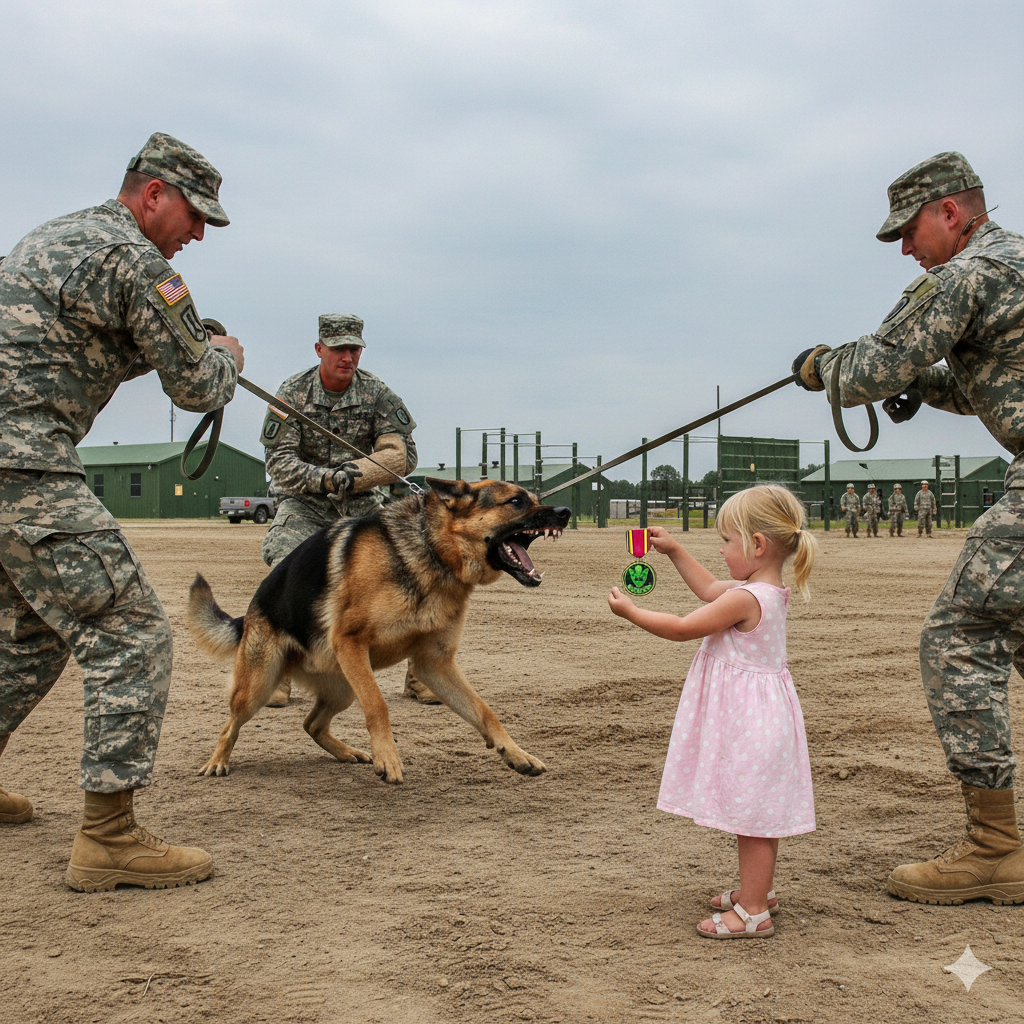
The words burst out almost simultaneously as a little girl, no more than seven or eight, stepped into the training yard.
Her brown hair was braided unevenly, her sneakers scuffed, her pink jacket hanging off her shoulders like it once belonged to someone bigger.
In her hand, she clutched something small — a round, green military badge, its edges worn and faded from years of handling.
Every officer froze.
“Get her outta there!” someone yelled. “That dog will kill her!”
But the girl didn’t even flinch. She kept walking, her small boots crunching over gravel.
Ranger’s head whipped around, his growl deepening into a guttural snarl. The chain rattled again.
Still, she moved forward — calm, unhurried, her eyes never leaving his.
Then something strange happened.
Ranger stopped.
The growl cut off mid-throat. His ears twitched. His body went tense, but his eyes — those wild, yellow eyes — softened, just a fraction.
The girl knelt a few feet away, careful not to reach out. Her voice was small, trembling slightly.
“Hi, Ranger,” she whispered. “I think… you knew my dad.”
The entire yard went silent.
The captain took a step forward, confusion etched on his face.
The girl lifted the badge, holding it out between her fingers. “He wore this when he came home from his last tour,” she said softly. “He told me about you. He said you saved his life in Kandahar.”
The officers exchanged stunned looks.
Ranger’s tail gave the smallest twitch. He lowered his head, sniffing the air, then let out a low, uncertain whine — a sound that broke something open in every person watching.
The girl took one more step closer. Tears shimmered in her eyes.
“He said you were the bravest soldier he ever knew,” she said. “That you never left him — not once.”
Ranger’s breathing changed. It slowed. His body trembled, but the fury was gone.
He took one step toward her. Then another.
And then, as if the weight of months of grief had finally crushed through his defenses, he collapsed forward, pressing his head gently against her knee.
The little girl’s hands shook as she touched him — first his ear, then his neck. The great dog whimpered, burying his muzzle into her jacket like a child seeking shelter.
“It’s okay now,” she whispered, her tears dripping onto his fur. “You did good, Ranger. You can rest.”
No one in the yard moved.

A young officer swallowed hard. “What the hell just happened?”
The K9 captain’s voice cracked when he finally spoke. “She reminded him who he was protecting,” he said quietly. “She reminded him he wasn’t alone.”
Later that afternoon, as the sun dipped low and painted the training yard gold, the girl sat on the grass with Ranger’s massive head resting in her lap. He was calm now — eating from her hand, tail swishing gently.
When her mother arrived, she froze at the sight. “Lila!” she gasped, running forward. But the captain stopped her gently.
“Wait,” he whispered. “Look.”
Ranger had rolled onto his side, letting the girl scratch his chest. For the first time since his handler’s death, the great dog looked… peaceful.
Lila’s mother’s eyes filled with tears. “I didn’t even know he was still alive,” she murmured. “My husband — he talked about Ranger all the time. Said he owed him everything.”
The captain nodded slowly. “He was one of ours before he joined the force. Your husband trained him after the Corps donated him to us. We thought maybe the connection would help.”
The mother wiped her eyes. “That badge,” she whispered, nodding to Lila’s hand. “It was his. The only thing she kept after the funeral.”
Lila looked up at the officers, her voice quiet but steady. “Can I come visit him sometimes? So he won’t be alone anymore?”
The captain’s throat tightened. “I think… Ranger would like that very much.”
Over the following weeks, the story spread through the department — the day a little girl brought back the most dangerous dog in the city with nothing but a memory and a piece of her father’s past.
Ranger was never aggressive again. He stayed at the station for a while, but the officers noticed something: he refused to settle unless he saw Lila.
When she visited, he’d wag his tail so hard he nearly toppled over.
Eventually, the captain called Lila’s mother.
“We’ve talked it over,” he said. “Ranger deserves a home — and he’s already chosen his family.”
That evening, Ranger rode home in the back seat of a beat-up sedan, his head resting on Lila’s shoulder as she hummed softly to him.
Months later, if you drove past the little house on Oakwood Lane, you might see them in the yard — a little girl with braids tossing a tennis ball, and a grizzled German Shepherd chasing after it, joy in every step.
Neighbors sometimes asked what made that old police dog so gentle with her.
Lila always gave the same answer, smiling as she rubbed the faded badge she still wore on a chain around her neck.
“He remembers my dad,” she’d say simply. “And I think… I remind him who he loved.”

Ranger lived out his days surrounded by laughter, warmth, and the family of the man he’d once protected.
He died years later, peacefully, with Lila by his side — her hand resting on his fur, the same green badge tucked beneath his collar.
And at his memorial, beneath the flag that once draped her father’s coffin, the K9 captain placed a small plaque that read:
“Ranger — Soldier. Protector. Hero. Forever faithful.”
Because some bonds — forged in war, sealed in loyalty, and mended by love — never truly die.
About the Author