

The ceremony flowed with polished, elegant sounds, but Jane Carter, the soldier, no longer belonged to it. She was a ghost among the sea of medals, the hum of protocol, and the proud applause.
At the Naval Command Headquarters, the air was thick with order and pride. The smell of polished brass and expensive cologne lingered. Footsteps echoed on marble floors, the muted jingle of medals punctuating the whispers of officers who had never known fire.
Jane sat in the last row, a gray jacket hanging loosely on her frame, hands folded over her lap to hide the scars on her knuckles—a map of pain, survival, and sacrifice. She did not belong here.
The fabric of her jacket was worn thin at the elbows. The scars on her wrists were old but permanent, a different kind of uniform that no one in that hall could understand.
Around her, officers conversed freely, blending small talk with ambition. A lieutenant whispered to his companion, questioning why a civilian was allowed at the restricted ceremony. His friend smirked, dismissing Jane as if she didn’t exist.
Jane did not flinch. She sat tall, head slightly bowed, listening to the polished noise as if it came from another world—a world she had only read about. Her world had been different: the low groan of a reactor under pressure, the sting of ozone in her lungs, the metallic taste of fear and steam.
Her eyes drifted to the oversized screen at the front of the hall, where recipients’ names scrolled continuously. Speeches about duty, honor, and service echoed through the room. Just words. Only words. None of them knew the truth of what she had survived.
Then, the atmosphere shifted.
Rear Admiral Thomas Pierce descended the aisle, the living embodiment of the institution that had erased Jane from all records. His uniform was crisp, his steps deliberate, measured by decades of command. He nodded to officers, offered brief smiles, laid a hand on a shoulder here and there, whispering words of recognition.
He was the one who had signed the report. The one who had listed Jane as “Killed in Action.”
As he walked past her row, his gaze stopped. It fell on Jane’s wrist, where her sleeve had shifted slightly.
He saw the circular burn marks. The scars from when she forced the manual override as the system fried—scars he had only seen in classified after-action photos.
He froze.

The polished hum of the room, the laughter, the clinking—everything went silent.
One second. Two seconds.
No one moved. Only the pounding of Jane’s heart filled her ears. The eyes of every officer in the room were on her, as if they were staring at a ghost who had returned from the dead.
His voice cut through the silence like a blade, calm and absolute:
“You’re her.”
Not a question. Not a doubt. A realization. An accusation.
The words hit the room like an invisible shockwave. Reflexively, every officer—captains, lieutenants, decorated men and women alike—stood at attention.
The scraping of hundreds of chairs echoed, deafening in the stillness.
No one understood why. All they knew was that their Admiral had seen something impossible.
For the first time that night, Jane sat alone in a sea of standing white uniforms. No one spoke. They just stared.
Jane stared back. Her gaze was calm, resolute, yet fierce.
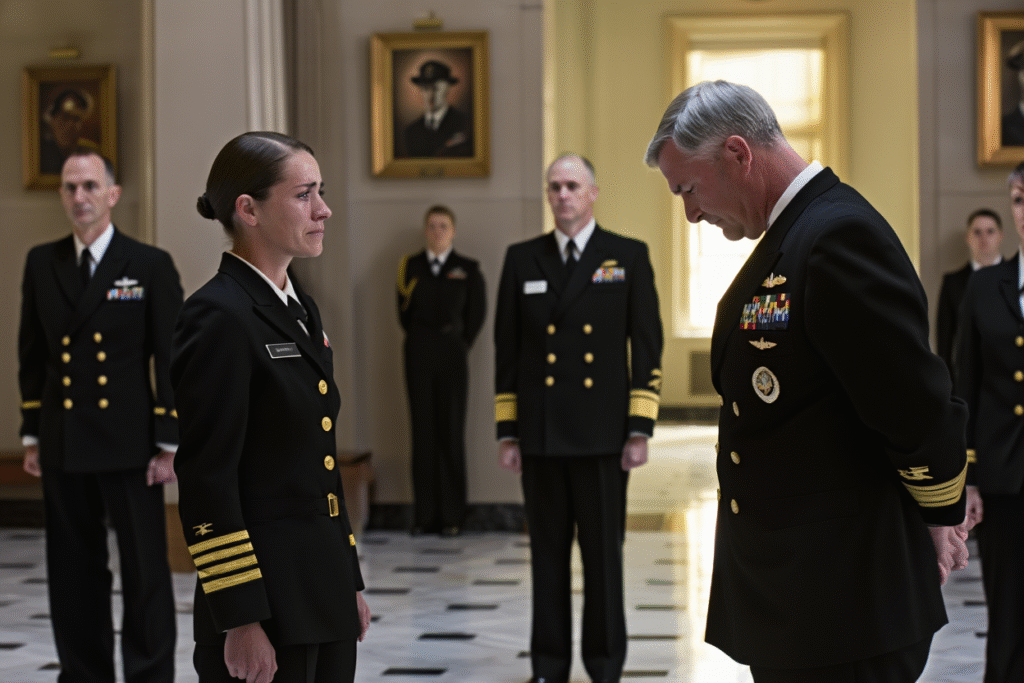
She had been buried alive in the records, erased, declared dead. But she had survived. She had saved 12,200 lives. And now, finally, the truth could not be ignored.
The Rear Admiral approached her, his steps slow, deliberate, the weight of decades of command behind each one. He stopped in front of her, bowed slightly in acknowledgment, and whispered:
“Welcome back, Lieutenant Carter. The Navy owes you everything.”
Relief and pride flooded her chest. For the first time in years, she allowed herself a small smile. She was no longer invisible, no longer a ghost. She was a soldier, alive, and honored—not for the paperwork, not for the applause, but for the lives she had saved.
And in that frozen, silent moment, Jane realized: sometimes survival alone was the greatest act of heroism.
About the Author