The morning sun had barely risen over Chicago when Sarah Mitchell walked into the small neighborhood bank where she worked. Her heels clicked sharply against the marble floor — precise, confident, and cold. Sarah was known for her professionalism, but also for her lack of warmth. To her, the world was divided into two kinds of people: those who mattered, and those who didn’t.
That day, the branch was quiet — until the door creaked open.
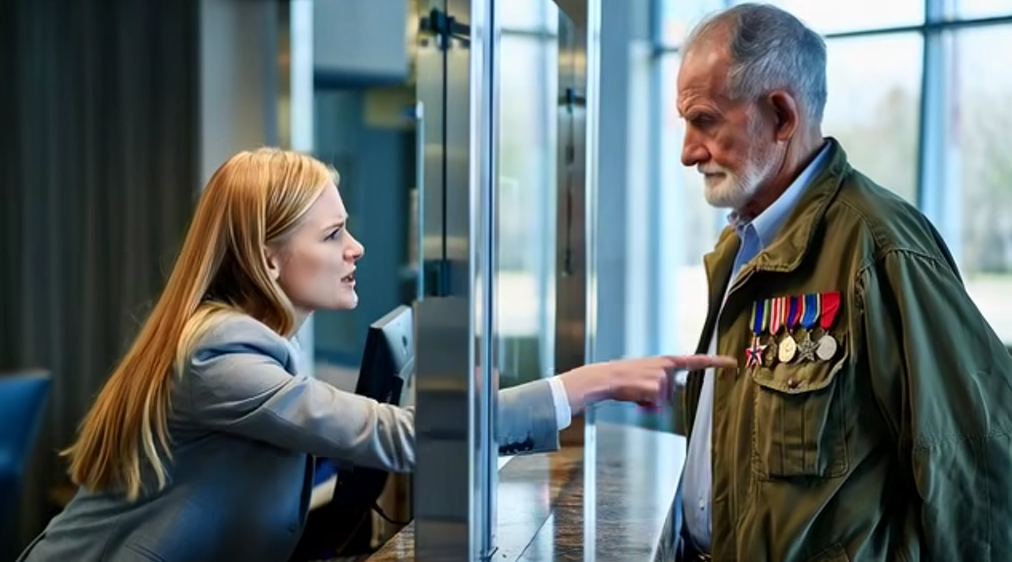
An elderly man stepped inside, his clothes faded and his jacket frayed at the edges. His silver hair peeked out from beneath an old military cap, and on his chest gleamed a few worn medals that caught the morning light. He walked slowly, his back slightly bent, clutching a stack of papers in his shaking hands.
“Good morning, miss,” he said softly. “I’d like to make a small transaction.”
Sarah looked him up and down, her lips tightening. “Do you have an appointment?” she asked curtly.
The old man blinked, taken aback. “No, I— I just wanted to—”
Sarah cut him off with a sigh. “Sir, we have procedures. You can’t just walk in and expect to be helped immediately.”
She snatched the papers from his hand, flipping through them with annoyance. Under her breath, she muttered, “People should really learn some manners.”
Her coworker glanced over, uncomfortable, but said nothing. The old man stood silently, his face unreadable. After a long pause, he simply nodded, took back his documents, and said in a low voice, “Have a good day, miss.” Then he left — slowly, quietly — the little medals on his chest glinting as the door shut behind him.
That night, Sarah didn’t give it another thought. She had done her job, she told herself. People like him… they came and went.
But the next morning, something was different.
When she arrived at her desk, there was a large envelope sitting neatly on top of her paperwork. No name. No return address. Just her name written on it — in delicate handwriting.
Curious, she opened it. Inside was a letter… and several documents.
The letter began:
“Dear Ms. Mitchell,
Yesterday, I came to your bank not as a customer, but as a man trying to settle an old account before it’s too late. You may not remember my name, but I remember yours. I served this country for forty-two years. The medals I wear are not for pride, but for the friends I lost so others could stand where I stood. Yesterday, for the first time, I felt invisible in the very country I once swore to protect.”
Sarah’s throat tightened as she read. Beneath the letter were bank documents — all official. The man’s name was William R. Hayes. The papers revealed he had a trust fund — a large one — and that the bank had been chosen to handle his estate. A sticky note was attached to the top:
“Please assign all matters of my account to Ms. Mitchell. I want her to understand what true service means.”
Sarah froze. Her hands trembled as tears blurred the words on the page. She read the last line of the letter again and again:
“Respect is the currency of the soul. Spend it wisely.”
Later that afternoon, the branch manager called an emergency meeting. Mr. Hayes had passed away that very morning — peacefully, in his sleep.
Sarah never forgot that day. The medals, the trembling hands, the quiet dignity she had ignored. From that moment on, she changed — not out of guilt, but out of gratitude. Every veteran who entered the bank from then on was met with a smile, a handshake, and a quiet “thank you for your service.”
And every morning, before opening her desk, Sarah would look at the framed letter hanging beside her computer — the one that reminded her that sometimes, the greatest lessons come wrapped not in anger, but in silence and an envelope.
About the Author