The rain was so cold.
But it wasn’t as cold as his eyes.
I stood there, my tiny sneakers soaked through, clutching Barnaby—my teddy bear. His button-eye was missing, and his fur was matted down from my tears. He was the only thing I had left of… before.
The sound of the dirt hitting my mother’s casket was a final, terrible thud. It was the sound of the world ending.
The crowd of strangers in black coats began to break apart, their umbrellas popping open like dark flowers. They all drifted away, back to their warm cars, back to their lives.
Soon, it was just me. And him.

The man who had married my mom. The man who was now the only “family” I had left.
He looked down at me, and his face was like stone. There was no sadness. No pity. Just… annoyance. Like I was a piece of trash left on his lawn.
“You’re not my responsibility anymore,” he hissed. His voice was low, cutting through the sound of the rain. “She’s gone. Get your things and get out of my house.”
I must have made a sound, a small gasp, because his face twisted in anger.
“Did you hear me? Get out.”
He turned and walked away, his shiny black shoes splashing through the mud. He didn’t look back.
He left me. He left an eight-year-old girl alone at her mother’s fresh grave.
My world didn’t just crack. It shattered. My father was a faded memory from years ago. My mom… my mom was my sun, my air, my everything. And now she was in the ground.
And I was completely, terrifyingly alone.
That night, I walked back to the house. The house I’d lived in, the house where my mom and I would bake cookies, the house that always smelled like her lavender perfume.
It wasn’t my house anymore.
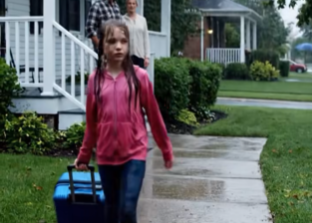
My little pink suitcase—the one with the Disney princesses on it—was already on the porch. Thrown there.
I walked up the steps, my heart hammering. Maybe he’d changed his mind. Maybe he was just angry.
I tried the doorknob. Locked.
I knocked, my small, trembling fist making a tiny pat-pat-pat sound.
“Please,” I whispered to the wood. “It’s me. It’s Emily.”
The porch light clicked off, plunging me into darkness.
I heard the click of the deadbolt. A final, metallic sound of rejection.
I sank onto the top step, pulling Barnaby into my chest. I couldn’t even cry out loud. It was a silent, racking sob that tore through my body. I was homeless.
The next few days—or was it weeks? Time blurred—were a nightmare.
I learned to be invisible.
I learned that people don’t see you when you’re small and dirty. You’re just part of the landscape. A piece of trash on the sidewalk.
I found an alley behind a bakery. It was warm, and sometimes, if I was lucky, I’d find day-old bread in the dumpster. My stomach ached with a constant, gnawing hunger.
My shoes fell apart. My clothes were caked in mud. I held Barnaby so tight, I was afraid I’d break him. He was the only one I could talk to.
“It’s okay, Barnaby,” I’d whisper into his matted fur, trying to stop my teeth from chattering. “Mommy is just… she’s just busy. She’ll be here soon.”
But I knew she wouldn’t.
At night, I’d try to sleep on a park bench, curling into a tight ball. Every sound—a siren, a car door, a person walking by—made me jump. I was so, so scared.
I prayed to my mom. I prayed for warmth. I prayed for food.
I prayed for someone to find me.
Then, one afternoon, the sky opened up. It wasn’t just rain; it was a cold, driving storm. I was huddled under a broken streetlight, trying to shield Barnaby with my own tiny body, shaking so hard I felt like I was breaking.
A car pulled up to the curb.
It was a black car. A fancy car. The kind I’d never seen up close. It was long, black, and silent.
I froze. Rich people were scary. They were the ones who called the police to have people like me “removed.”
The back window-lessened, a smooth, silent whirr.
I saw a man inside. He had silver hair, and he was wearing a suit and tie. But his eyes… they weren’t angry or disgusted. They looked… kind.
He leaned over, his voice warm and soft. It was the first kind voice I had heard in forever.
“Child,” he said. “Goodness, why are you all alone in this storm?”
I was too scared to speak. I just stared.
“Where are your parents?” he asked, his brow furrowed with a deep, genuine concern.
That broke me. A single, hot tear rolled down my cheek and mixed with the cold rain.
I held up Barnaby as if for protection. “I don’t have anyone left,” I whispered. My voice was a tiny, broken croak.
The look that crossed his face wasn’t pity. It was… recognition. A deep, profound sadness I felt I’d seen in my own mirror.
The car door opened.
He stepped out, right into the pouring rain. He didn’t seem to care about his expensive suit. He took off his heavy wool coat—it smelled like leather and… safety.
He knelt in front of me, on the wet, dirty sidewalk.
He wrapped the coat around my shoulders. It was huge. It swallowed me, and for the first time in so long, I felt a flicker of warmth.
“My name is Carter,” he said. “It’s going to be okay now. I promise.”
He held out his hand.
I looked at his warm, dry hand. I looked at my own, caked in dirt.
I hesitated. Then, slowly, I put my hand in his.
He didn’t just help me up. He lifted me. He carried me, and Barnaby, to his car and wrapped me in a blanket that felt like a cloud.
That night, I slept in a real bed. A bed softer than anything I’d ever known. I had a hot meal. I had a warm bath that washed away the dirt and the alley-smell.
I slept for almost 15 hours.
But the new world was just as scary as the old one.
I woke up screaming, thinking I was back on the bench. I’d flinch whenever Mr. Carter moved too quickly. I hid food under my pillow, terrified it would be my last meal.
I didn’t know how to be a normal kid. I only knew how to survive.
The kids at the new, fancy school were cruel in their own way. They whispered. “That’s the orphan.” “He’s a millionaire. She’s his charity case.”
I felt like that piece of trash again, just in a cleaner wrapper.
But Mr. Carter… he was different. He was patient.
He never got angry when I had a nightmare. He would just sit in the hallway outside my door until I fell back asleep. He came to every school event, sitting in the front row, even when I was just “Tree #3” in the school play.
He’d hold my hand when we crossed the street. He’d remind me, every single day, “You are safe, Emily. You are loved.”
One day, he sat with me in the library of his huge home. He showed me a picture. A little girl with blonde pigtails, laughing.
“That was my daughter,” he said, his voice thick. “She… she was in an accident. Years ago.”
He looked at me, and his eyes were swimming. “I’m a very rich man, Emily. But all the money in the world couldn’t fix the hole in my heart. I thought… I thought I’d never be a father again.”
He touched my cheek. “And then, in the middle of a storm, I found you.”
He wasn’t just saving me. I was saving him, too.
But my past wasn’t done with me.
One day, the doorbell rang. I went to answer it, and my blood turned to ice. It was him. My stepfather. He looked… smaller. And greedier. His clothes were rumpled, and his eyes darted around, taking in the marble foyer. “So,” he sneered at me. “You landed on your feet. Hit the jackpot.” I backed away, “What… what do you want?” “What do I want?” He laughed a dry, ugly laugh. “Heard your new ‘dad’ is loaded. Well, she’s still my responsibility, technically. Raising a kid is expensive. I’m here to collect.” I was trembling, transported back to the graveyard. “Emily? Who is at the…” Mr. Carter’s voice trailed off as he came around the corner and saw us. He saw my face. He saw the man. His kind, gentle face hardened into something I’d never seen. It was absolute steel. “Get behind me, Emily,” he said, his voice quiet, but full of power. I scrambled behind his legs. Mr. Carter stood tall, radiating an authority that my stepfather just couldn’t match.
“She is my responsibility,” my stepfather repeated, trying to sound tough. Mr. Carter took one step forward. “No,” he said. “You gave up that right when you abandoned an 8-year-old child at a cemetery. You gave up that right when you threw her suitcase on the porch and locked the door.” “You don’t know…” “I know everything,” Mr. Carter cut him off. “She is my daughter. In every way that matters. And you… you are trespassing. You will leave this property now. And if you ever come near my child again, I will use the full force of my resources to ensure you regret it.” My stepfather’s greedy smirk vanished. He saw that Mr. Carter wasn’t just a rich man. He was a protector. He stammered, took a step back, and then turned and practically ran down the walkway. I watched him go. And for the first time, I wasn’t scared of him. Mr. Carter turned, his face instantly softening. He knelt and pulled me into the biggest hug of my life. “He’s gone, Emily,” he whispered into my hair. “He is gone. And he will never hurt you again. You’re home.”
I was. I was finally home.
Mr. Carter legally adopted me. My last name changed. The last piece of my broken past was gone.
Years went by. The nightmares faded. The flinching stopped. I found my voice. My mom had always said I had a gift for art. Mr. Carter built me a studio. I painted. I painted the darkness—the alleys, the rain. But then, I started painting the light. I painted Mr. Carter’s kind eyes. I painted the warm yellow of my new bedroom. I painted Barnaby, sitting on a shelf, safe and whole. My art told my story. A story of loss, but also of resilience. Of finding hope in the middle of a storm. Today, my paintings hang in galleries. I give talks, telling people that it’s okay to be broken… because you can be put back together. My stepfather is a distant, pathetic memory. My father… my dad… is Carter. He’s older now, his hair completely white. But his eyes are still just as kind. He still sits in the front row of all my art shows. People always ask me how I overcame it all. How I escaped the darkness. And I always tell them the truth. “Love saved me. The love my mother gave me, which made me strong enough to survive. And the love my father gave me, which taught me how to live again.” “Family,” I tell them, “isn’t about the blood you share. It’s about who shows up in the storm to wrap you in their coat.”
About the Author